Hot Desk, Fixed Desk or Private Office: What the Difference Means Day to Day
The difference between a hot desk, a fixed desk and a private office comes down to how much of the space is yours. A hot desk means taking any free seat in a shared area each time you come in, a fixed desk keeps the same desk reserved for you in that shared area, and a private office gives you or your team a lockable room of your own.
Price usually rises in that order, but the bigger change is to your routine: where you sit, what you can leave behind at the end of the day, where you take calls and how much you hear from the people around you. This guide looks at what each option is like on an ordinary working day, so you can choose the one that fits how you actually work.
What working from a hot desk is like
A hot desk works on a first-come, first-served basis. You arrive, pick any free seat in the coworking area and set up for the day, then clear the desk when you leave so someone else can use it tomorrow.
In practice, this means carrying your laptop, charger and anything else you need each day. Some spaces offer lockers for hot desk members, but you should not expect to leave papers, a second monitor or a favourite chair in place overnight. On a quiet morning you can choose the seat you like best, while on a busy day you may need to settle for whatever is free.
Calls are the other part of the routine to think about. Short calls are usually fine at the desk, but longer video meetings are better taken in a phone booth or a bookable meeting room, which means moving around the building during the day.
The benefit is flexibility. Hot desking suits freelancers, remote employees and hybrid workers who come in two or three days a week, travel often or simply want a professional place to work without paying for a desk that sits empty when they are away. Because you sit somewhere different each time, it is also the easiest way to get to know other members.
What working from a fixed desk is like
A fixed desk, sometimes called a dedicated desk, is a desk reserved for one person in the shared coworking area. Nobody else sits there, so you can leave your monitor, keyboard, notebooks and other equipment set up from one day to the next.
The day starts faster because there is nothing to unpack. You know where you are sitting, your screen is already at the right height, and the people around you tend to be the same faces each week. Many fixed desk memberships also include personal storage, such as a pedestal or locker.
What does not change is the room itself. You are still working in an open, shared space, so background conversation, people walking past and the need to step away for longer calls are much the same as on a hot desk. You also pay for the desk on the days you are not there.
A fixed desk usually makes sense for people who come in most days of the week, rely on a second screen or specialist equipment, or simply work better with the same set-up every morning.
What working from a private office is like
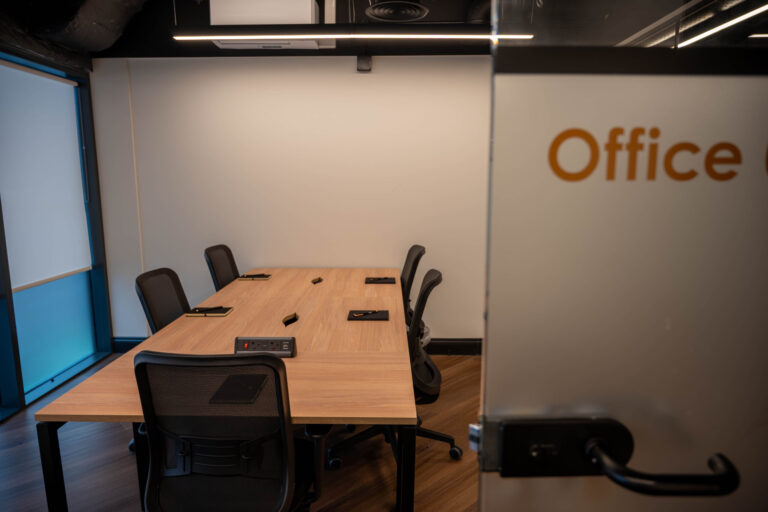
A private office is a lockable room for an individual or a team, set within the wider workspace. It is the closest thing to a conventional office, but the building, reception, cleaning, utilities and shared facilities are managed for you.
The day-to-day difference is privacy and control. Your team sits together, you can talk freely, take calls and video meetings at your own desks and leave everything in place, including confidential paperwork. You can usually arrange the desks to suit the way the team works, and nobody else uses the room when you are not there.
Private office members still have access to the shared parts of the building, such as the kitchen, lounge areas and meeting rooms. That means you keep the social side of coworking when you want it, and can close the door when you need to concentrate.
A private office costs more than a desk in the shared area, because you are paying for a whole room rather than a single seat. It tends to suit teams of two or more, businesses that handle sensitive information, and anyone who spends a large part of the day on calls.
Hot desk, fixed desk and private office compared
| Hot desk | Fixed desk | Private office | |
|---|---|---|---|
| Where you sit | Any free seat in the shared area | The same desk in the shared area | Your own lockable room |
| Leaving things overnight | Usually not, unless lockers are provided | Yes, at your desk | Yes, in the office |
| Taking calls | Short calls at the desk, longer ones in a booth or meeting room | Short calls at the desk, longer ones in a booth or meeting room | At your own desk |
| Noise and privacy | Shared open space | Shared open space | Private, with the door closed |
| Contact with other members | Most, as you sit in different places | Regular neighbours | When you use the shared areas |
| Typically suits | Freelancers and hybrid workers in a few days a week | Individuals in most days with a fixed set-up | Teams and confidential work |
How to choose the right option
The right choice depends less on job title and more on the shape of your working week. A few practical questions usually point to the answer:
- How many days will you come in? If it is one to three days, a hot desk keeps costs down. If it is most days, a fixed desk or office avoids paying to set up from scratch each morning.
- How much of your day is spent on calls? Regular video meetings are much easier in a private office than in a shared area.
- What do you need to leave set up? A second monitor, printed files or specialist equipment point towards a fixed desk or office.
- Are you working alone or as a team? Two or more people who need to talk through work together often find an office more practical than neighbouring desks.
- How sensitive is your work? Confidential client information, HR matters and financial details are easier to protect behind a closed door.
Your needs are also likely to change. Many people start on a hot desk, move to a fixed desk as they come in more often, and take a private office once they hire their first employee. Choosing a workspace that offers all of these lets you change your arrangement without moving buildings.
Hot desks and private offices at Apex in West Hampstead
Apex is a neighbourhood workspace on West End Lane for freelancers, small businesses and growing teams who want a professional base close to home. Members can choose a hot desk membership in the coworking area or a private office for teams of 2 to 20, with room to move into a larger space as the business grows.
Whichever option you choose, the day-to-day essentials are taken care of. Members have superfast Wi-Fi and printing, a reception team to welcome guests and take deliveries, and access to the Apex Lounge for coffee and breaks, with discounts for members. Dogs are welcome too.
Private office members also get 24/7 secure access and monthly meeting room credit, so client meetings and team sessions can be booked without an extra bill. Offices come with no set-up fee, and the address can be used as your company’s registered business address.
The building is a short walk from West Hampstead’s Jubilee line, Overground and Thameslink stations, which makes it an easy commute from Kilburn, Hampstead, Swiss Cottage, Cricklewood and other parts of north-west London.
Book a tour of Apex on West End Lane, or contact the team to enquire about hot desk memberships and current private office availability.